Wednesday, September 28, 2016

More of My Embarassing Childhood Writing

I did this a while ago, but I am going through stuff in my room, and that includes a giant stack of notebooks so... time to go through some of my old childhood writings again and have a good chuckle.

Sesame Street notebook. Age 11 or 12.

"Susie opened her eyes, looking around the new world. Then she closed her eyelids, already tired of the new scenery. Mommy smiled, and closed her eyes as Susie had." [So much eye closing!!]

Or how about this tagline: "Susie's life is perfect.... until kindergarten!"

Some random notes...


"Mud War 
- about a mud war...
Pain of ten thousand Men
-slavery
-made-up
-more to come"

Selections from a temporary journal. 2008 (age 14)

March 31st. "Jeepers, [my brother] needs to get a life. All he does is video games and soccer... I wish he'd think of something else to do or at least Mom and Dad make a limit for him because he does it non-stop, he's been so boring ever since grade six. What happened to my fun brother? Oh well. I'll live."

Still March 31st. "Oh, I'm going. [My brother] left. [My sister]'s dancing. Everyone seems to be wanting to occupy the washroom. This is boring. Who would want to read this?" [I was really bored that day, apparently.]


Kitty Dream Journal. Age 12 or 13. 

A story titled "The Reign of Birthstones". "A snow queen had settled in our land! She claimed it for her own, and captured trolls for comrades! 'Emerald, should we do something about the Snow Queen?' Topaz asked. 'I guess we must. I heard of a young healer, Turquoise. Her magic abilitys may be of help,' I said. Just our luck, Turquoise had been coming to the Country daily, so we had a chance to speak to her. She was a rumor, at first. She was merely just our greenhouse gardner!" [I'm so confused.]


Notebook with dog on the front, along with "MUFFLER" written in pencil on the front. Age 11. 


"About the author: Alyssa loves writing and crafts. She is eleven and has no idea how she thought of writing this book. This is a part re-written version of Muffler. Alyssa usually does not write stories about animals." [A+ bio, little Alyssa.]

"Chapter One: Wishing. I raised my head high and let the wind play around in my fur. This flat plain was quiet. Very quiet. Almost, too quiet. Crickets chirped, bees buzzed the wind whispered and the grass swayed, making the flat plain more lively. I twisted my head, searching for trees to hide under, out of the hot sun. I looked back to the city, bright with lights. That's where I would be sleeping tonight, like always. Might as well head toward. So I trotted towards the clump of pollution, garbage and unwanted pets."

Note on the inside cover: "'Muffler' is cancelled.'"

Weird velvet notebook with embossed flower on it [who gives a notebook like this to a fifth grader!?] Age 10. 


"I wish I lived in a mansion. This is how I would want to be... Ding Dong! The doorbell rang. Probaly just another annoying boy. thought Jordyn. All the girls in Mrs. Steaurts class [Mrs. Steaurt was my grade 5 teacher], including Mrs. Steart live in a mansion. The girl's families also lived in the mansion. Each family had a nice-sized house-room in the mansion. The rule of the mansion was if there was a annoying boy or man they would give a punishment then put him in the "Annoying Servants" room."

Another scene:

"'A maze? sinch. locked in cupboards? Have a paper clip with you. Covered in duck tape? Rip it off,' said the new boy. 'DON'T' yelled the boys. 'Why not?' asked the new boy. The boys looked at each other. 'The glowing ring,' they whispered."

[Oh man, this story is hilarious - it is about my fifth grade class living in a mansion and torturing all the boys in my class. I don't think I liked the boys in my class very much...]

Well, those are just a few of some old writings of mine. Maybe now you can understand better  Why I'm Glad I Wasn't A Teen Author ;).

What do you think is the funniest line of some of my old writings? What is the most ridiculous thing you wrote when you were younger?

Wednesday, September 21, 2016

Why I'm Glad I Wasn't A Teen Author

[This post has been sitting in my drafts for a year or more, for no good reason, so I'm posting it now, with some minor edits.]

So before I start, a disclaimer: teen authors (by this I mean published teen writers) are great. There are a ton of them, and as a young teen I collected those names to stuff into my mental box of heroes. (I actually have some blog posts listing teen authors, in fact). I think it is awesome that teens get published young, and I say good for you, if you accomplish something like that.

However.

I wouldn't be surprised if every young teenage writer aspired to get published before their 18th birthday. I daydreamed of it so many times. I would get an agent. People would email me, asking for interviews on how someone so young would get an agent. My local newspaper would have an article about me. My teachers would hold up my book in class. Peers would suddenly be name-dropping my name. "Oh, yeah, I went to school with that girl. Yup, she had poofy hair and didn't talk much, but she was so cool. But yeah, I knew her."

This post is maybe just a way of making myself feel better for not being published as a teen, but I think that's legitimate. I think it's okay to say that I like how my life has turned out, and the reasons for it.

So, here are some reasons why I'm glad I wasn't published as a teen.

1. My writing still has a long way to go

I thought my writing was pretty good (at least my family told me so haha) as a teenager. Maybe it was, comparatively. But when I look back on anything I've written, especially stuff I wrote as a 13-15 year old, I cringe. Everything needs work, as far as I can tell. (And that's just me. I'm sure any critique partners would notice much more). But I'm glad I didn't put that work out into the world and that instead I let myself just write, practicing and improving over time.

2. No pressure

This might not be a good thing, considering how much I don't prioritize my writing, especially when I have schoolwork to do. But I'm glad that I am able to write on my own terms, and don't have to worry about deadlines or anything. I can make my own goals for myself, and jump all over the place with genres and such, and just enjoy writing and creating story and characters.

3. No job

Publishing a book is a business. This is obviously something not a lot of 13-year-olds would realize, and I certainly didn't. But publishing a book is a business, and being an author is a job. What 13-year-old wants that kind of responsibility? I sure didn't.

4. I can still have fun

I've had so much fun with my writing. I enjoy writing, because I do it for me. I enjoy reading, because I do it for me. Once you become an author, you have to be careful of everything you say about books and fellow authors. And your writing is always being picked a part. As a non-professional reader and writer, I have a lot of freedom.

5. I learned a lot

I have had the opportunity to learn so much, about publishing, about writing, about interacting with writerly people online (almost entirely thanks to this blog). If I would have been published at a young age, I think I would have stumbled through a lot of the process, and rather messily at that.

All of that being said, someday I still hope to be published, but I definitely don't think it's too late just because I'm exiting teenagerdom. Being a success at a young age doesn't make you more of a success, which is definitely something that I've had to come to terms with.

Basically I'm just really thankful for the way that my writing and reading and thoughts about both have been developed, as well as my involvement in the online writing community.

I'd love to hear your thoughts. What are your thoughts on teen authors? Did you daydream about being one? Do you wish you would have worked harder to be published earlier? 

Editor's note:
So I probably wrote this more than a year ago, since I said I was "exiting teenagerdom", and I have been a legal adult for four years now. To be fair, I never really did the work of trying to get published - writing queries, researching agents, committing to a thing for more than three drafts... But that's because I didn't want to. My 13-year-old self might be horrified at me now - I'm already so old and I still don't have a book out! Sorry, 13-year-old me, I've been busy doing other things, and you know what, it's been great! Also publishing is maybe not all it's cracked up to be! Leave me alone!

Basically, if you happen to be a young writer reading this, just write. Worry about everything else later. 

I'll leave you with this quote from Anne Lamott's Bird by Bird:


"Publication is not all that it is cracked up to be. But writing is.”


Friday, September 16, 2016

Growing Up

I just recently came across this post on Tumblr, and it hit on a lot of things I have been thinking for the past year and a bit. The poster talks about some of their reasons for reading YA as an adult; because YA is fast-paced and fun to read, not because they want to relive being a teenager, which is a common assumption about adults who read YA.

YA is often looked down on as a book category, most likely because it is a woman-dominated industry (I encourage you to read Nicole's amazing and in-depth Sexism in YA article), and as a result there are quite a lot of people in the YA online community constantly defending YA as a legitimate category. People go through the arguments every time another YA-bashing article comes up (which is a lot, it's getting old): YA has a place; there are awful YA books and there are awesome YA books, just like there are awful adult books and awesome adult books; one is not more "mature" or necessarily better than the other.

I started this blog when I was 15. I'm 22 now. I have been involved, to some extent, in the YA book community for most of that time, so people's fierce defensiveness of YA has worn off on me. A few years ago, probably when I was 16 or 17, I thought that I would never stop reading YA, or being interested in it. It never occurred to me that I would ever start to lose interest in reading YA, because that's all I read, all the time, and I loved it. When my mom said that sometimes YA was too much for her, I thought, well I'm not going to become a boring, no fun adult like that! I am going to read only YA until I die! (Sorry mom).

Well, as it turns out, YA actually is mostly just for teenagers. Who knew that my mom would be right?

Right now, I feel like I am in an awkward transitional phase between YA and adult, and it manifests itself in a giant book slump where I don't feel like reading anything. I'm not as interested in YA, but I am also not quite ready to give it up entirely yet. I don't really have a go-to place for books anymore. 

The adult fiction (and nonfiction) world is so wide. I don't even know where to start. I knew what YA I liked, I knew where to go and what authors to read. I don't really know where to go to find books I like yet. And while I want to find a place I can go to to find good books, I don't want to limit myself to any one genre either, because I know I can find good books in any number of genres.

Then there's the whole other thing of finding fun books. Some of the best adult books I've read recently haven't really been light reading. Pictures at A Revolution by Mark Harris was gigantic and the current book I'm reading, Ice Diaries by Jean Mcneil is really well written, but very dense. Like that Tumblr post pointed out, I don't really want to read about teens anymore, but I still want to read fun books, books with good characters and fast-paced, interesting plots, that are easy and quick to get through, and a lot of the time, you can find that in YA.

What do you think? Have you read a good, fun and fast-paced adult book with good characters that you could recommend to me? Why do you read YA? Do you have a similar experience?

Friday, May 13, 2016

3 Reasons to Read Boring Girls by Sara Taylor


METAL. MAYHEM. MURDER.
A visceral story of friendship, music, and bloody revenge 

Rachel feels like she doesn’t fit in - until she finds heavy metal and meets Fern, a kindred spirit. The two form their own band, but the metal scene turns out to be no different than the misogynist world they want to change. Violent encounters escalate, and the friends decide there’s only one way forward . . .

A bloodstained journey into the dark heart of the music industry, Boring Girls traces Rachel’s deadly coming of age, Fern at her side. As the madness deepens, their band’s success heightens, and their taste for revenge grows ravenous. (From ECW Press website

For anyone who knows me, you might be thinking, after reading that description of Boring Girls, "wait, she picked up that book and she liked it?" (You might also be thinking, wait, she picked up this book and wasn't scared by it? The answer to which is yes, of course I was.) But yes, I did like it, and here are some reasons why I think you should read it too!

1. THE PACKAGING To start with, the tagline, the cover, and the summary are great, and are all things that made me want to pick up the book in the first place. It just sounded really intense and interesting, never mind that I don't think I could ever bring myself to listen to heavy metal, and I'm not a huge fan of violence in the media I consume. But trust me, Boring Girls lives up to its packaging.

2. GIRLS! I know it's in the title, but this book is about girls - girls friendships, problems, issues, and challenges they face in a predominantly male industry. There wasn't a weird forced romance in it or anything. Actually, one of the reasons I liked this book was how authentic it felt to the real teenage girl experience - or at least my experience as a teenager. I mean, minus the metal and murder. Rachel was more concerned in high school with being taken seriously and finding a bond with other girls than dating, and I feel like that experience is often missing from the books I read, especially YA (although I wouldn't characterize Boring Girls as YA, even if the characters are teenagers). I honestly don't think it's realistic or constructive to have every female protagonist's story centered on getting a guy over everything else, especially female friendships. Anyway.

3. THE INTENSITY I was definitely never bored while reading it. While you know that Rachel and her friend are murderers from the beginning, that doesn't spoil the intensity or the anticipation leading up to the actual event. It was written well, and while there were a lot of descriptions of Rachel's band getting big rather than an actual build-up to the end, it was still interesting and a fascinating look at the life of musicians, female musicians in particular. And Sara Taylor definitely accomplishes the feat of making you sympathize with a murderer. By the end, you kind of feel like Rachel did the right thing.

Boring Girls is anything but boring, and I highly recommend you check it out! 

Boring Girls on ECW Press
Boring Girls on Amazon.ca
Boring Girls on Amazon.com
Boring Girls on Goodreads


Saturday, April 2, 2016

Review: Life Among the Qallunaat by Mini Aodla Freeman

In my attempt to read more indigenous fiction this year, I picked up Life Among the Qallunaat by Mini Aodla Freeman. I didn't realize it when I took it out of the library, but this book was only just recently re-published, in 2015, after initially being published sometime in the 70s. 

It has a very interesting history behind its publication, including controversial things about residential schools being cut out, and the government buying three thousand copies of the book and hiding them away for years. It never really got the attention it deserved, though, so a bunch of professors from the University of Alberta decided to re-edit it and put it out into the world again, this time attempting to respect the vision of the author in their editing. (If you do pick up this book, I highly recommend you read the afterword by the editors, which overviews the history and importance of this story to Canadian indigenous literature). 


Anyway, Life Among the Qallunaat is a memoir about a young Inuit woman, Mini, and her experiences growing up in the north of Nunavut and her and her family's interaction with the "qallunaat" (the Inuktitut word for white people or English speakers; literally, "people who pamper their eyebrows"). It starts with Mini in "the South" (Ontario), and her experience feeling out of place in the unfamiliar culture of the South. Then eventually the story goes back to her growing up in Nunavut and the various ways her culture adapts to missionaries and other outside influences,  as well as her experiences attending residential schools, and eventually leaving the North to be a translator for the Canadian government in Ontario. 

The book is split up into little short stories with very fitting titles (which is apparently a change that Mini Aodla Freeman made for the republished version), and I ended up reading two or three of her stories every night before bed. I found reading about Mini's life fascinating and also comforting. Every night, I looked forward to reading another part of Mini's life and her take on it. I loved Mini's voice and found her so relatable, since she talked about how she was painfully shy. However, even though she talked about how she was super shy, I was amazed at her resilience and insight into her situations and other people around her. Her insights about cultural differences are so, so great. Here's a great section that really struck me:

“Some [qallunaat] are nice and kind, but none want to see or understand my Native culture. Some don’t want to know, some don’t have time, some try but find it too deep to understand or accept. They all want to cover it up with their ways. They always want me to be different, a novelty, and they refuse to see that I am a plain human being with feelings, humanity, pain, joy, happiness, gratitude, and all the other things that every other being was capable of having, doing, thinking and acting. They think that the Inuit were nothing but a bunch of smiley, happy people. They never stop to think that Inuit, too, are capable of killing and murdering, just as their society is full of. They want Inuit to dress and talk like them, and to forget their own ways. Yet they will never really accept the Inuit fully. They want us to remain different from them as cold is from hot.”- Mini Aodla Freeman, Life Among the Qallunaat.

Just, wow. I just think the way she analyzes the way people think about other cultures is so spot on, even today, thirty-eight years after its original publication. I think there are a lot of people (including myself) that need to realize these things about people from different cultures. Her story is so important and so relevant, and I'm so glad that it was republished in 2015 so that I had the opportunity to read this amazing woman's story. 

Life Among the Qallunaat at U of M Press
Life Among the Qallunaat on Amazon
Life Among the Qallunaat on Goodreads


Friday, March 25, 2016

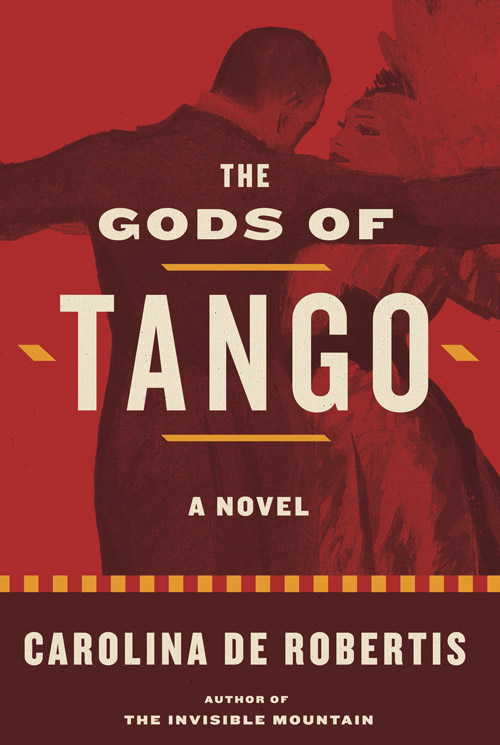
Review: The Gods of Tango by Carolina de Robertis

I'm not the kind of reader that sees movies in my head when I read. Sure, I have a pretty good imagination, but books come alive for me in different ways than concrete visual images in my head. However, the way some books are written they just can't help but come to life for me, and The Gods of Tango was definitely one of those books. 


The Gods of Tango is a book set in the early 1900s, about a young girl, Leda, who immigrates from Italy to Argentina in order to join her husband (who is also her cousin) Dante. When she gets to Argentina and discovers Dante was killed, she decides to leave the dark secrets of her hometown and stay in Argentina. She has to survive on her own in Argentina somehow, so she disguises herself as a man so she can do the one thing she's fallen in love with the most in this new country: play the tango. 

The tango becomes the thread that weaves itself throughout the entire book and Leda's love for it drives her as she tries to make a life and name for herself in Argentina. Carolina de Robertis' descriptions of the tango and the atmosphere that surrounds it are absolutely gorgeous. She makes the tango, and with it the setting of 1900s Argentina, come alive. Reading this book was a deliciously sensory experience. You can really hear the dance of the tango, feel the rhythm of the music, and smell, taste, and hear what it is like to be a musician on the Argentinian tango scene. I felt like I was there with Leda, feeling, hearing and tasting everything she was, and able to bask in the richness of it. Reading Carolina de Robertis' writing is basically like eating dessert.

The Gods of Tango is a beautifully written book with an absolutely captivating story about love, identity, and, of course, tango. If you want to be entirely immersed in this beautiful setting and the rich love story at the centre of it, then I highly suggest you pick it up! 

Author website - Carolina de Robertis' Twitter

Monday, February 15, 2016

Who the Hell is Louis Riel

Happy Louis Riel Day! Louis Riel Day is a holiday in my province, Manitoba, celebrating one of the most famous (and infamous) French Canadians in history. 

I don't know how much you know about Canadian history, but if you've learned a bit, you've probably heard of Louis Riel. I learned about him in Canadian history in high school, but I only remember snippets. I remember something about an execution of a horrible man called Thomas Scott that had something to do with Riel, that Riel was part of the creation of Manitoba as a province, that he was part of the Red River Rebellion which had something to do with the Métis, and that there was a huge weird debate about Riel's sanity after the rebellions he was involved in. And, of course, I remember that he was hanged.

Then last year for my Across Canada Reading Challenge I read Louis Riel: A Comic Strip Biography by Chester Brown, which is a great visual account of Riel's life and involvement in the Red River Rebellion. Louis Riel was a Métis (an indigenous peoples of mixed race), and spent basically all his life fighting for the rights of Métis people to their own land. This is what the Red River Rebellion was all about - getting the Canadian government to recognize a government made up of Métis and English that would be just and able to look after the interests of the Métis people. There was much back and forth between the Métis people of the Red River and the Canadian government, and it even got to the point of actual battle between the Métis and Indians and the Canadians. Louis Riel was at the head of this fight for Métis rights, and was looked up to as a leader and inspiration for many Métis and French Canadians. He was also super religious, to the point where he kind of made up his own branch of Catholicism (with flavours of Protestantism), and deemed himself Prophet of the New World. The comic strip biography often portrays Riel's religion among the battle for the Métis people as something comedic and out of place. There was one panel where there is a battle going on around him, and Riel is in a trench praying, and it comes across as absurd


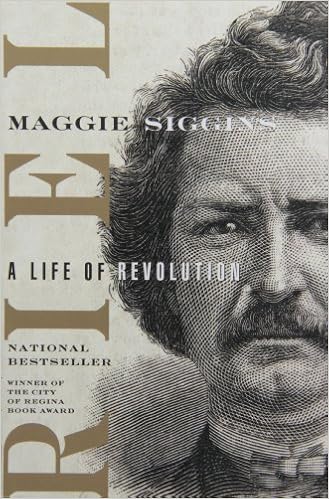
At the end of his biography, Chester Brown recommended a book which he said was the best book he's read on Louis Riel, Maggie Siggin's Riel: A Life of Revolution. I was intrigued by this strange, contradictory figure, and it turned out my dad owned a copy of the book, so I thought I would try to read it. 

Maggie Siggins does a superb job of exploring Riel's life and character as a revolutionary and leader of Métis people's rights. Reading this book, I went from having a picture of Riel as a religious lunatic who had some involvement in the rebellions of the Red River area to understanding how Riel's religious zealousness evolved alongside his intense loyalty to his people, the Métis. For his entire life, all he wanted was to provide what was best for the Métis - that their land claims would be recognized, that they would have a government that would recognize and deal with their concerns, and later on when that didn't work, that they would be able to create their own independent nation. 

Unfortunately, none of Louis Riel's grand dreams came to fruition. Reading this book about all of the struggles of the Métis amid the creation of Manitoba as a province, it struck me how relevant all of these issues still are today. Aboriginal people are still fighting against the government over land claims and still are not given equal status and recognition in Canadian society. The themes that exist in the story of Louis Riel and the Métis people, of the government ignoring and resisting the voices of Aboriginal people, still continue today in many ways. 

Maggie Siggins sums up Riel beautifully in the last few sentences of Riel: A Life of Revolution

"He was a complex man full of contradiction and angst, certainly, but what makes Louis Riel so intriguing is that he managed to straddle two cultures, Native and white, and came as close as anyone to envisioning a sympathetic and equitable relationship between the two. That Canadians may someday achieve this vision remains Louis Riel's legacy."

I really hope that Louis Riel's vision of an equitable relationship between Canadian Aboriginal people will be realized, and soon, and I have come to appreciate him for being instrumental in creating this vision.


LinkWithin

Related Posts Plugin for WordPress, Blogger...