Showing posts with label Canada. Show all posts

Monday, April 24, 2017

Local Book Nook #1: Manitoba, Canada


So the first person to be featured on my new Local Book Nook blog series is... me!


If you don't know, Local Book Nook is a blog series I just started today. It is a blog series featuring readers from all over the world talking about their favourite local books and authors. If you would like to learn more or if you would like to be one of these featured readers, go here or comment below with your contact info and I will contact you!

Where are you from?

I am from Canada, in particular the beautiful and often underrated prairie province Manitoba. There is a book called If You're Not From the Prairie that basically sums up my experience as a Manitoban. As a prairie girl, what other people call flat is often nowhere close to what I consider flat. I have been witness to many beautiful prairie sunsets, and I have felt the fierceness of the prairie winds in all seasons.


Manitoba has a great literary scene which I have really only dipped my toe into at this point. There are a lot of great prairie writers, lots of prairie literary magazines (one of my favourites is Prairie Fire), publishers, a literary festival, and great local bookstores that promote and feature a wide variety of books, including a great section featuring local prairie authors.


What are some of your favourite local books or authors?

While searching for local books I have read, I discovered that there are a ton of local authors whose work I've never read. I need to fix that! Anyway, here are a few of my favourite local authors whose work I have read:

1. Perry Nodelman and Carol Matas (Of Two Minds, More Minds)


I think I was probably nine or ten when I first read their MG fantasy, Of Two Minds. It was about two characters from two different kingdoms - Princess Lenora, who was from a kingdom where the subjects could make their dreams a reality, and Prince Coren, from a kingdom where the subjects could read minds. They get pushed together, and Lenora's fierce personality and Coren's much more subdued one make a perfect pairing. Everything about this book and its sequel (now I think it has two sequels?) I loved - the premise, the characters, the world building. It was so fascinating that I remembered the plot perfectly, even years later. I found it at a used book sale, reread it, and it was still as good as ever. I also realized that Lenora and Coren's relationship had subconsciously influenced my own writing, as I had created two characters in a fantasy series that were based on them. Anyway, when I came back to it years later, I found out that Perry Nodelman and Carol Matas are actually from Winnipeg, Manitoba, which made me unbelievably excited.


2. Katherena Vermette (North End Love Songs, The Break)

Katherena Vermette is becoming more and more well known on the Canadian literary scene, especially with her newest novel The Break, which was actually featured on CBC's Canada Reads this year. I have yet to read The Break (I am planning to soon!) but I have read her first poetry book, North End Love Songs, which just perfectly depicts what it is like growing up in one of the rougher neighbourhoods of Winnipeg. Her writing was absolutely exquisite and so effective at drawing out emotion. It struck me while reading her short book of poetry that she would make an excellent novelist, so I am excited to read her book.


3. Miriam Toews (A Complicated Kindness, Swing Low: A Life, All My Puny Sorrows)
 
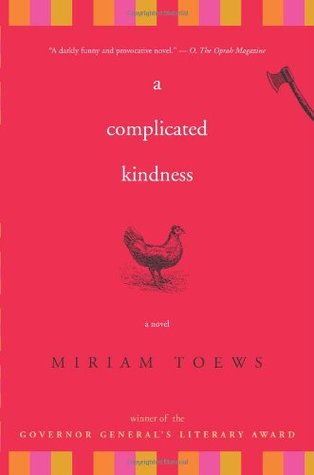
I feel like if you are going to learn anything about Manitoba and some of the people that make up its population, you should read anything and everything by Miriam Toews. The first book of hers that I read was A Complicated Kindness, which was the book that launched her into Canada-wide fame. Then I took a Mennonite literature class (fascinating stuff), and reread A Complicated Kindness, enjoying it even more the second time. I've also read her books Swing: Low A Life and All My Puny Sorrows. All her books deal with the suffocation and sorrow of growing up in the stifling environment of conservative Mennonite communities in southern Manitoba, and the consequences of that. But she is also able to write these deeply sorrowful stories with a unique sense of humor that perfectly captures the inconsistencies of the people she portrays. A Complicated Kindness in particular I found laugh out loud funny. I would definitely encourage you to pick up one of her books.


So those are just a few Manitoba authors that I love, although I could talk about more if you want me to! ;)

And don't forget if YOU want to do a post sharing about your favourite local authors, either leave a comment with your contact info, email me at asherlockwrites(at)gmail(dot)com, or Tweet/DM me on Twitter!

Wednesday, March 1, 2017

30 Travel Tips From My Trip to Vancouver!

Is this post just an excuse to brag about my trip to Vancouver and show you a whole bunch of snazzy pictures? Why yes, it is. Here are some things I learned on this fun trip, which hopefully you can apply to YOUR next fun trip so you don't make some of the same mistakes I did. And check out the previous travel post I did about why traveling is GREAT for introverts like me! Don't worry, I will be back to regular bookish programming next week.

~*~*30 THINGS I LEARNED ON MY TRIP TO VANCOUVER*~*~

1. Fill up your water bottle at the water fountain once you're past airport security - you brought an empty water bottle for a reason, you know.

2. Bring gum on the plane to chew when you're ascending and descending to help your ears pop (I have to credit my sister for this tip - it's her #1 travel tip for flying on a plane, which she has done once.  I know, I should've listened to her.)

3. If you're going to Vancouver in February, bring warm gloves/mitts.

4. Also bring warm socks, especially if your shoes are runners with a million holes in them (because they're mesh, and also old).

5. Also bring a scarf for the cooler days.


6. Also maybe a hat, or at least one of those headband things to cover your ears. (At least it is not windy in Vancouver, though.)

7. Whenever you travel (or even in your own city), make friends with people from all over the world so you can stay at their house when you visit their hometown.

8. Connect with locals because they know way more than you and can show you/direct you to cool stuff. Listen to their recommendations! Or write them down for next time.


9. If you can, host people yourself so they will be more willing to let you stay with them in the future to repay the favour.

10. Don't eat out for every meal if you're not used to it.

11. Don't drink tea right before you go to bed.


12. When you first arrive, it is never going to go like you expected, but don't worry, it'll get better.

13. Be flexible. (Very important!!)

14. Don't put pressure on yourself to have the most fun all the time; enjoy the highs AND lows. It's all a learning experience.

15. Get lost! (But be safe.)

16. Walk places, you see more and get to know places better.

17. Take transit. You see the city better, learn how to get around your own, and don't have to figure out parking.

18. Don't be too set on your plan. Actually, don't be set on plans at all because they WILL change.

19. Take lots of pictures.


20. Don't forget to take pictures of yourself, too, and the people you're with.

21. Google Maps is great for finding random attractions and restaurants.

22.  Get a good sleep over doing more things so you can actually enjoy and have energy for the things you do.

23. If it's cold outside and you have a couple of hours to kill and need somewhere quiet and free (with Wi-Fi) to hang out, find a local library.


24. Pack your backpack as light as possible, or get one of those backpacks with a chest strap so your shoulders aren't aching (as much) by the end of the day.

25. If you are deathly afraid of heights, don't walk over a giant bridge with sketchy side railings.


26. Rent bikes and bike around Stanley Park if you're in Vancouver! Yes Cycle has cheap rates, only $5/hour and they only charge you after you get back. This was probably my favourite thing that I did.

27. Instead of eating out all the time, buy some groceries and make your own meals. Cheaper and better for you! And then you can eat as soon as you're hungry instead of walking around trying to find somewhere when you're starving. (But also treat yourself and try local food, too.)

28. Take breaks. You don't have to be going all the time.

29. Bring thank you gifts for people who host you.

30. It's your vacation! Do what is most fun for you, which might be ziplining, or it might just be hiking through a magical forest.


Monday, February 15, 2016

Who the Hell is Louis Riel

Happy Louis Riel Day! Louis Riel Day is a holiday in my province, Manitoba, celebrating one of the most famous (and infamous) French Canadians in history. 

I don't know how much you know about Canadian history, but if you've learned a bit, you've probably heard of Louis Riel. I learned about him in Canadian history in high school, but I only remember snippets. I remember something about an execution of a horrible man called Thomas Scott that had something to do with Riel, that Riel was part of the creation of Manitoba as a province, that he was part of the Red River Rebellion which had something to do with the Métis, and that there was a huge weird debate about Riel's sanity after the rebellions he was involved in. And, of course, I remember that he was hanged.

Then last year for my Across Canada Reading Challenge I read Louis Riel: A Comic Strip Biography by Chester Brown, which is a great visual account of Riel's life and involvement in the Red River Rebellion. Louis Riel was a Métis (an indigenous peoples of mixed race), and spent basically all his life fighting for the rights of Métis people to their own land. This is what the Red River Rebellion was all about - getting the Canadian government to recognize a government made up of Métis and English that would be just and able to look after the interests of the Métis people. There was much back and forth between the Métis people of the Red River and the Canadian government, and it even got to the point of actual battle between the Métis and Indians and the Canadians. Louis Riel was at the head of this fight for Métis rights, and was looked up to as a leader and inspiration for many Métis and French Canadians. He was also super religious, to the point where he kind of made up his own branch of Catholicism (with flavours of Protestantism), and deemed himself Prophet of the New World. The comic strip biography often portrays Riel's religion among the battle for the Métis people as something comedic and out of place. There was one panel where there is a battle going on around him, and Riel is in a trench praying, and it comes across as absurd


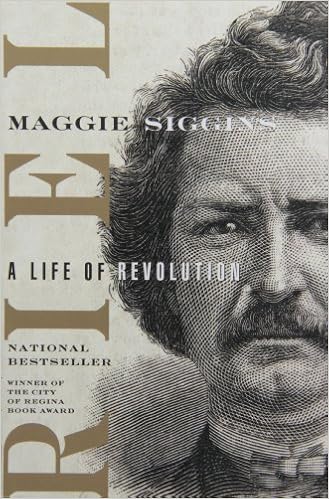
At the end of his biography, Chester Brown recommended a book which he said was the best book he's read on Louis Riel, Maggie Siggin's Riel: A Life of Revolution. I was intrigued by this strange, contradictory figure, and it turned out my dad owned a copy of the book, so I thought I would try to read it. 

Maggie Siggins does a superb job of exploring Riel's life and character as a revolutionary and leader of Métis people's rights. Reading this book, I went from having a picture of Riel as a religious lunatic who had some involvement in the rebellions of the Red River area to understanding how Riel's religious zealousness evolved alongside his intense loyalty to his people, the Métis. For his entire life, all he wanted was to provide what was best for the Métis - that their land claims would be recognized, that they would have a government that would recognize and deal with their concerns, and later on when that didn't work, that they would be able to create their own independent nation. 

Unfortunately, none of Louis Riel's grand dreams came to fruition. Reading this book about all of the struggles of the Métis amid the creation of Manitoba as a province, it struck me how relevant all of these issues still are today. Aboriginal people are still fighting against the government over land claims and still are not given equal status and recognition in Canadian society. The themes that exist in the story of Louis Riel and the Métis people, of the government ignoring and resisting the voices of Aboriginal people, still continue today in many ways. 

Maggie Siggins sums up Riel beautifully in the last few sentences of Riel: A Life of Revolution

"He was a complex man full of contradiction and angst, certainly, but what makes Louis Riel so intriguing is that he managed to straddle two cultures, Native and white, and came as close as anyone to envisioning a sympathetic and equitable relationship between the two. That Canadians may someday achieve this vision remains Louis Riel's legacy."

I really hope that Louis Riel's vision of an equitable relationship between Canadian Aboriginal people will be realized, and soon, and I have come to appreciate him for being instrumental in creating this vision.


Tuesday, September 8, 2015

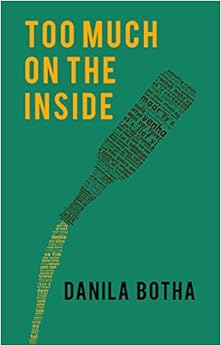
CanLit Reviews: Too Much on the Inside by Danila Botha

Full disclosure: the author sent me a copy of this book in exchange for an honest review!

Too Much on the Inside is a simple, short book about four characters from all across the world converging in one spot in Toronto. There is Dez from Brazil, Marlize from South Africa, Nicki from Israel, and Lukas from the east coast of Canada. The book is told with alternating POVs from each of these four characters. Throughout the book you get to see their interactions with each other, and learn about their lives before moving to Toronto in short snippets. I honestly think a lot of people would enjoy the simple, straightforward style of this book and the small observations about life from the places these characters are from, as well as in Toronto.

However, I kind of wanted something that went deeper. The writing was very simple, and I felt like I was being told the characters' emotions instead of really feeling the characters' emotions. I think it had the potential to be a really beautiful, emotional story with the lives of these four characters' intertwining, as well as learning from their pasts and moving forward. The premise is great, which is what made me want to pick up the book in the first place. But it just stayed on the surface level, and relied on ancient tropes and cliches rather than doing anything new or interesting. Even the problems that each character had had an obvious solution, which was just postponed until the end when the characters conveniently found themselves and realized something that I could have told them after the first couple of chapters.

I liked the idea of the story, but it just didn't work for me, because it didn't make me feel anything. I didn't care enough about the characters to want to spend more time with them after the last page.

You can find it on Goodreads here.
Danila Botha's website

Sunday, July 19, 2015

Across Canada Reading Challenge Part 2: The Territories

If you weren't already aware, I finished my Across Canada Reading Challenge, which is a mini-challenge I gave myself as part of the Around the World Reading Challenge. I talked about the books I read set in each of the 10 Canadian provinces yesterday, and today I'm going to talk about the books I read that were set in each of the three territories. The three territories are the Yukon, Northwest Territories, and Nunavut. I didn't know this until now, but apparently the difference between provinces and territories is that provinces receive their power from the Constitution Act, and and the territorial governments get power from the federal government. 


YUKON

For the Yukon I read The Slow Fix by Ivan E. Coyote, which is a collection of short stories about the life of the author. A lot of the stories were about what gender is or should be, and different people and society's interpretation of it. There were also a few stories that were focused on the author's upbringing in the Yukon. I loved this book, it was such a fun and entertaining read. I think I was smiling the entire time I was reading it. It was so nice to read something light and funny, but also intelligent, after reading many brain-stretching books. The author had such a perfect quirky voice that brought life to the everyday stories she told, but also had good things to say. I think even if you aren't into reading it'd be a good book to read, since the stories are short and entertaining.

NORTHWEST TERRITORIES

For this territory I read Late Nights on Air by Elizabeth Hay. This was a book set in the 1960s or 1970s, about the community at a radio station in Yellowknife. At the same time as it was about this northern radio station, there was also the issue of a pipeline and native land rights in the background. That was interesting to read about, especially since the same kind of thing is happening now. However, it was mostly a simple, very slow moving story about the lives of the staff at this radio station. Although it was slow, I found myself getting attached to the characters and their relationships with each other anyway. The best part, though, were the descriptions of the land in the north that make you feel as if you were a part of this epic landscape, just as much as the characters in the book.


NUNAVUT


I read Consumption by Kevin Patterson, which is set in a bunch of different places in Nunavut, and some characters also spend some time in Manitoba. (The author himself is from Winnipeg). This was a really interesting book. It followed the life of a handful characters, centering around the life one Inuit girl, Victoria, and her life after she contracts tuberculosis. She's then sent to Winnipeg for an operation, and when she comes back she feels removed from her original culture, and she goes on to marry a white man. The book goes on to follow the lives of various characters who live in the north, from Victoria's kids and parents, to a couple of teachers at one of the schools, to a few other characters who live in the same community. It covers quite a few years, from when Victoria is a young girl to when she has grandkids, I think. One of the major themes is definitely how the culture changes in this northern community over those years, and how each of the characters are affected by that. 

I loved reading about the North of Canada, just because it's so very different and removed from the rest of Canada. (I do regret that I didn't read any books set in the territories by Aboriginal authors, though). There are two similarities that are prominent in each of these Northern stories. One is the theme of land. It's amazing how much the place itself defines the people that live there. Life in the north, the characters and authors of these books tell me, is something beautiful and special and something that you don't understand if you haven't experienced it for yourself. In each of the three books, the descriptions of the land and the natural atmosphere completely take you in and transport you to that place and time. The other theme, in contrast with the theme of the natural, harsh landscape, is that of the loss of culture (indigenous culture in particular) to Western cultural values and consumerism. In one of the stories in The Slow Fix, Ivan E. Coyote talks about how one of the cities in the Yukon has been taken over by Walmarts and McDonalds. The entire story in Consumption is about how many of the indigenous characters have been taken away from or have no choice but to turn away from the only way of life they knew previously, that is living off the land. 

I think the last line of Consumption brings these two themes together beautifully: 


“The narwhals surface in the bay, waving their tusks in the air; only a few miles out of town, the last of North America’s great herding land mammals, the tuktu, caribou, paw the grass and the moss by the many thousands and shiver collectively when they smell predators approaching. Contained within this beauty, and perhaps its necessary consequence, are the people here—who huddle similarly close and watch for one another’s peril.”


Saturday, July 18, 2015

Across Canada Reading Challenge Part 1: The Provinces


This year I decided to take part in the Around the World Reading Challenge (which you probably know since I've mentioned it in like every blog post this year.) As a part of that challenge, there are a bunch of mini-challenges that you can take part in, like read a book from a certain number of countries. One of the suggested mini-challenges was read a book set in every state, but I decided to switch it to read a book set in every Canadian province and territory, since I'm Canadian. (Also I'm sure I've already read a book set in almost every US state, which just shows you how much influence American media has).


It was really fun reading a whole bunch of Canadian books and learning more about my country and the varying cultures within it. If you're American, you have no idea how much American media often swamps other countries' local media. Most people I know watch a lot of American TV and movies, and probably 90% of the YA I read growing up was set in the US and written by American authors. It's probably the worst in Canada, since we share the same language, similar culture, and a border. 

The thing is I probably know more about what makes an American novel than a Canadian one. It's really fun to see how even though a lot of the time I think of Americans and Canadians as being essentially the same, Canadians really do think differently than Americans do. That difference comes across in the books that I read for this challenge. The stories that Canadians choose to tell are very different from the ones Americans tell. Of course, this is only the beginning of my adventures in CanLit, so I can't make too many sweeping generalizations.

For now, I'll just talk about the books I have read so far. I thought I'd split this post into two since otherwise it would be way too long, so in this post I'll talk about the books I read from each province, and then in Part 2 tomorrow I'll talk about the books I read from each territory.

BRITISH COLUMBIA

We'll start on the West Coast with BC! I actually ended up reading three books set in BC. The first was Beauty Plus Pity by Kevin Chong, which I did a review of so you can see what I thought here. It's an easy to read but also very interesting family story about a second-gen immigrant from Hong Kong. Another book I read set in Vancouver was Everything Was Goodbye by Gurijinder Basran, about a girl who struggles with the culture and wishes of her Indian family by falling in love with a white man. The story follows how the MC experiences the culture clash her entire life. I also read The Beckoners by Carrie Mac which is set in Abbotsford. That was a very intense YA book about extremely violent bullying. I think I liked the other Carrie Mac book I read, The Opposite of Tidy, better.


ALBERTA

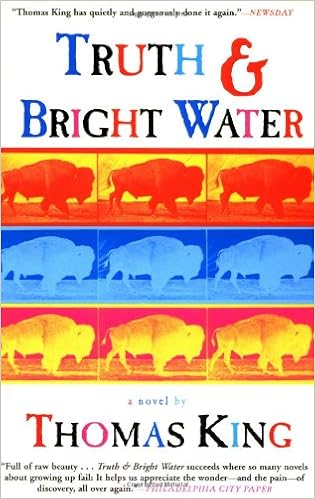
Onto the land of black gold. The book I read for this province was Truth and Bright Water by Thomas King, about the life of a young Aboriginal boy and two towns on either side of the US/Canada border. While doing this challenge I also read a lot about and the stories of Aboriginal people. I always find it interesting reading Aboriginal stories, because the way Aboriginal people think is very different from the way I think. Truth and Bright Water was an easy read, and fairly humorous despite one of the characters constantly saying that what's wrong with Indians is they have no sense of humor.


SASKATCHEWAN

I had so much trouble finding books set in SK. The province has such a tiny population, so there's only a small percentage of published books about it written by Canadian authors and whose books I actually have access to. I ended up reading Dust by Arthur Slade, which was a younger YA about a weird magician-like person who puts a spell on a town in Saskatchewan during the Dust Bowl. I think this book was just a bit too young for me to enjoy. It was weird thinking of Saskatchewan during the Dust Bowl as a place for magic to happen, though.


MANITOBA

My home province! I read Louis Riel: A Comic Strip Biography by Chester Brown. If you don't know the name Louis Riel, well you should learn it. He's thought of as one of the founding fathers of Manitoba, although the actual history is a little bit less straightforward. That was the fun thing about reading this biography, is you realize just how not straightforward history is. Louis Riel was one weird dude, that's for sure. I also read A Complicated Kindness by Miriam Toews, who is a prominent Manitoban and Canadian writer. A Complicated Kindness is a story about a young girl growing up as a Mennonite and her struggle with her culture. Mennonite stories are a huge part of Manitoba, so it was interesting learning more about that culture.


ONTARIO

It is not hard at all to find books set in Ontario, considering that's where most of the population of Canada lives. I read The Unlikely Hero of Room 13B by Teresa Toten, which focuses on a young boy with OCD and his affection for a young girl in his group; Skim by Mariko and Jillian Tamaki, a short graphic novel about a Korean girl and her trials at school in Toronto, and Lies Beneath by Anne Greenwood Brown, a book about murderous mermaids who live in Lake Superior. It's an interesting concept, mermaids who live somewhere considerably less tropical and oceanic.


QUEBEC


For Québec, I read Cockroach by Rawi Hage which is about an immigrant making his way in the diverse community of Montreal. It was very much about the difficulties of being a Canadian immigrant. It's interesting because a lot of the time in the news and stuff you read about all these happy ending Canadian immigrant stories, that Canada has rescued these people and Canada's so great and welcoming and multicultural and all that. But this book, as well as Drive-by Saviours, shows a very, very different experience of Canadian immigration, one that people don't hear about as often, but is nonetheless still true to the experience.


NEW BRUNSWICK
 

I read a short book called Summer Point by Linda Mcnutt, which was about the longstanding effect of staying at a cottage for one summer in New Brunswick on one woman's life. The writing was very subtle, which I liked, but I felt like it could have gone into a lot more depth with the characters. It was just too short of a book to really flesh out the character's and their stories. I did enjoy the short story that I did get to read, though, it was well-written and the story flowed quite well.


NOVA SCOTIA

One thing I noticed when trying to find books set in the Maritimes is how many books set there are historical fiction. The Birth House by Ami Mckay was a historical fiction novel about a midwife set in the early twentieth century. It was mainly a novel about women's rights, especially in regards to giving birth. It also touched on the theme of white men coming in and taking over and ignoring the voices who know better in order to give something that they think is better but really isn't, which is a common theme in a lot of the books I've read. But I felt like it was too obvious what the author was trying to say, and it came off kind of preachy. I think truths in fiction need to be more subtle.


PRINCE EDWARD ISLAND

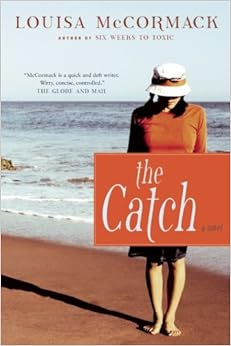
I read an adult romance book called The Catch by Louisa Mccormack, about a middle-aged business
woman finding herself by spending a summer in a small town on PEI. It wasn't a bad read, but I didn't feel like the main character really learned anything by the end which was disappointing. My favourite part was definitely the small town PEI atmosphere of it. I loved how the story of family and friends and neighbours who all know each other was at the heart of the book.


NEWFOUNDLAND AND LABRADOR

I read February by Lisa Moore for this province, about a woman dealing with her husband's death. It was also tied in with the story of her son getting some girl he met in Iceland pregnant and trying to avoid doing what his mother thinks he should do. It was okay, but it was just too slow for me. There were too many details that felt unnecessary to me, and that didn't really give any greater insight into the characters or story.

Well, that's it for the provinces, stay tuned for tomorrow, when I'll go over the books I read set in the North: Yukon, Northwest Territories, and Nunavut!


Friday, July 3, 2015

CanLit Reviews: Drive-by Saviours by Chris Benjamin

If you've followed my blog for any amount of time, you'll know that I love reading books that make me think. I love books that stretch my brain and make me step outside of my own world to consider someone else's. Drive-by Saviours accomplished that excellently. In fact that was kind of what I felt the book was about, people learning to consider other people's stories. 


The book centres around two characters. One is Mark, a white Canadian living in Toronto who finds everything in his life mundane from his social work job to his partner, and who used to want to save the world but is now stuck in a rut. The other part of the story is the life of Bumi, whose story begins when he's a young boy on a small island in Indonesia and follows him through all his struggles into adulthood. As you could probably guess, the paths of the two men meet when Bumi immigrates to Canada.

The stories of both characters are told eloquently and incredibly carefully. There are a lot of scenes or chapters that seem to be out of place in the moment, but come to fit smoothly into the story later on. The writing is incredibly concise and captivating, and the clever twists of words enraptured me with each character's story. The places as well as the characters come alive through the author's writing.

Just listen to this description of Ottawa in one of Mark's chapters:

"The city that never wakes up, which has no culture, houses the highest bureaucrat-per-capita rate outside Geneva, has the seventh coldest winter temperatures of any nation's capital, bans alcohol after midnight and litter before, smells like carbon monoxide and feels like ether, celebrates smog and humidity with the bland cultural products of Canadian content law and draws more people for its tulip festival than any other event, is the city that produced the woman I loved."

Of course the main thing I thought about throughout this entire book is, how do these stories even connect? Even after Bumi and Mark met I kept trying to figure out what the two characters were learning from each other. A lot of the time it seemed like nothing, although of course that may have been the point. 

The commentary on social issues relating to immigration, development and modernization was great. You can see through Bumi's story how he is affected by the do-good attitude of outsiders his entire life, and how that destroys him. Then on the other side is Mark, the example of the wannabe social justice warrior and almost accidental white saviour figure. Not only do the themes of the book focus on the various trials and realities of immigration to Canada, but also the ups and downs and missteps of development work. Mark feels unfulfilled his entire life because he feels he's not helping people enough, and then when he meets this downtrodden immigrant he wants to help him for all the wrong reasons.

I find all of this stuff fascinating, probably because of my interest in international and cross-cultural development. But I'd really encourage you to check out this book. Not only is it a fascinating cross-continental story, but it touches on important and current issues. Even if it is fictional, I'm sure the stories reflect the situations of many real Canadians. (Also you should read it because I really want to discuss it with someone).

Find it on Goodreads here.
Amazon.ca
Amazon.com
Chris Benjamin's website 
Chris Benjamin's Twitter 

Monday, June 15, 2015

Je reviendrai, Québec

Salut, tout le monde! 

Well, I am back home from my five week French immersion program in Québec. It was an amazing experience, but I am also glad to be back home, where everyone speaks English and where the landscape is ridiculously flat. Dorothy was right when she said there really is no place like home. 

I thought I'd just take some time and talk up the program I did. The program is called Explore and is offered through the Canadian government. Anyone can do it (there were a few Americans in my program) but only Canadian residents are eligible to receive the bursary that pays for everything except your transportation. If you're Canadian, I would definitely suggest doing it. Your entire 5 week trip only costs whatever your flight/train/bus/gas costs, and you get to learn French! Even if you're not Canadian, you can still do the program, you just have to pay. 


Explore is an awesome program for improving confidence in French, especially oral. There was a lot of focus on speaking French. We had classes where we're encouraged to talk, conversation classes, and activities with the animateurs (the hosts who are native francophones) so we get to talk to francophones. The best thing about the hosts is that it's their job to be patient with you as you learn French. It's a great environment, because you get to feel comfortable talking and practicing with the animateurs, and then you can go out and talk to francophones in the city!


A hike to Cap Tourmente with students and hosts!
 There are Explore programs all across Canada, both English (for francophones) and French (for anglophones), but the one I went to was at Université Laval in Québec City. I can't really judge since I've only been to one program, but I honestly think the Laval program is the best. Laval is a bigger university and has been doing language exchange programs for years and years, so their program is super organized. They have a big focus on making you speak French, so you learn a lot in the 5 weeks. We were given bracelets the first week that identified us as either beginner (blue bracelet), intermediate (red), or superior (yellow). I was amazed at how much people with blue bracelets learned. At the beginning, they knew a few words, and by the end they could hold entire conversations! 

I was a red bracelet, so I could understand fairly well and speak enough to get by, but I definitely noticed an improvement in my own French as well. By the end, I could understand pretty well and felt like I could communicate well enough to get by living in Québec. The biggest thing though was definitely building up confidence. One of my friends commented on how her confidence had improved more than her actual ability to speak well, and she summed up it by saying, "They're going to hear my French whether they like it or not!" This is a great attitude to have if you want to learn a language, because you have to use it in order to practice and get better. And if you're too scared to use it, well that's not going to get you anywhere. 


Saturday hike to Mont du Lac des Cygnes, with the most incredible views.
The program itself at Laval is very strict about making you speak French, so it's an awesome environment to learn. The other thing is that the Québecois in Quebec City don't always automatically switch to English if you speak to them. Sometimes people switch, but a lot of people acknowledge your effort and the fact that you're trying to practice and will keep speaking French to you. There were were only a handful of people that spoke back to me and my friends in English when we spoke French to them. That's just another reason to go to Québec City if you really want to learn French, rather than Montreal or anywhere outside of Québec. 

Another reason to go to Laval is because there is a ton of stuff to do in Quebec City! There are some Explore programs at universities in smaller towns, but there is not as much to keep you entertained during your free time in afternoons or on weekends. The Université Laval campus is surrounded by malls, shops and little streets with cafés and cute little trinket shops. It's also about a fifteen minute bus ride from Old Quebec, the main tourist attraction, and the main metro bus goes right through the university so it's super easy to get around the city. 


One of the optional afternoon activities - painting!

The Laval Explore program itself organizes tons of activities. They have activities either at the university or around the city every afternoon, as well as a choice of three outing activities every Saturday. If you go on these activities with the university, that are led by the hosts, you get the chance to speak French even more. Sometimes it was difficult hiking up a mountain while also trying to speak French, but it was fun! 

I did the spring session (May-June) but they also have a summer session (July-August). If you are interested in going to Université Laval or doing an Explore program, I would love to chat with you or give you advice on what to expect or what to do in Québec City. Even if you're reading this months after it's posted, leave a comment, shoot me an email at asherlockwrites(at)gmail(dot)com or contact me on Twitter @asherlockwrites!

Monday, September 16, 2013

5 Things I Found Weird Upon Returning to Canada


A few months ago, I stood on Canadian soil again for the first time in 10 months. Those 10 months I spent in the Philippines, working at international school (if you don’t know that already). It was really good to be home, but it was definitely a switch!
 
It was a lot less of a culture shock than I expected, but that makes sense since I only spent 10 months of my life so far in the Philippines and 18 years in Canada. Still, there were a few little things that threw me (and still kind of do). I thought I’d share those things with you, and in doing so give you a glimpse into little bits of my life in the Philippines.

 
Things I thought were weird when I got home:


1.    Hearing Canadian accents.

My first entry into Canada was in Vancouver before we were to catch our connecting flight home, and there was a woman volunteer guiding us in the right direction, and the last thing I expected to come out of her mouth was a Canadian accent, but it was there! I mean, it makes no sense that I would think that, because I was in Canada but...

...the Philippines is on the other side of the world from North America, so it isn’t a popular tropical vacation destination for North Americans. Why fly for 24 hours when you can get to Cuba in four? Also, Americans are everywhere because there are so many of them, and there are not very many Canadians. Basically, if you see a white person (which is rare enough), they are American unless proven otherwise by their accent or other distinguishing characteristics.

In short, I was not used to hearing Canadian accents, so it surprised me when I did hear them! (Also, when I see people wearing Canada shirts, I still think in my head excitedly, They’re wearing a Canada shirt!! And then I remember that I’m actually currently IN Canada and it makes sense and I do not need to bond with them in my head over being from the same country and finding each other on the other side of the world).

I wore my Canada shirt climbing Mt Pinatubo... and met two Canadians as a result! Yay.

2.    A significant decrease in outdoor activity after 9 PM.

It was so weird to see stores closed and only a few people milling about on the streets once it got dark. In downtown Manila, there are ALWAYS people around and up and about, and always a lot of people, too. Seriously, you could get caught in the middle of a traffic jam at 4 AM. I guess that’s what happens in a city of around 16 million. It was still weird when I got home that the city actually quieted down and activity actually decreased at night.

3.    The weather!!!

This is probably the biggest one. In Manila, the temperature stays the same every day, and all day, only dropping a couple of degrees once the sun goes down. Once I got home, I kept forgetting that the temperature increases significantly throughout the day and decreases significantly into the evening.

In Manila, I would wake up, decide what to wear by how hot I was feeling at that moment, and be fine (albeit hot but that’s pretty much inevitable) for the rest of the day. Here, I have to think of how it might get warm later and layer and decide whether to suffer being cold or hot and remember to bring a sweater if I’m going to be somewhere after the sun goes down... the weather in the Philippines may be hot and humid, but at least it’s uncomplicated!

4.    Toilet paper in public washrooms.

There is no toilet paper in any public washroom in the Philippines, and sometimes even no toilet seat. Back home now, I keep forgetting that, and when I’m on the way to a public washroom I think in the back of my mind, Do I have Kleenex in my purse? And then realize that I don’t need it! There will be toilet paper in the stall! To be honest now that I’ve thought about it (and done it for a year), it’s not really that big of a deal to carry Kleenex in your purse and not have toilet paper in stalls. But it is a very nice luxury for North America to provide, that’s for sure.

5.    The weight of Canadian coins also threw me for a while, because it’s a lot lighter than the huge Philippine pesos and other coins.

 
So, these were a few things that threw me upon returning to Canada, but for the most part everything was actually completely normal and familiar – which was probably the weirdest thing of all!

Have you ever experienced culture shock in your own country?

LinkWithin

Related Posts Plugin for WordPress, Blogger...