Sunday, September 13, 2015

CanLit Reviews: Kabloona in the Yellow Kayak by Victoria Jason

Just in case you weren't aware, I just recently finished my Across Canada Reading Challenge, where I read a book set in every Canadian province and territory. After I had finished reading books from every territory, my dad talked about a book he knew that was set in Northern Canada that had been written by a relative by marriage who had kayaked through the Northwest Passage. It turned out my grandma had a copy of the book, called Kabloona in the Yellow Kayak, which she kindly lent to me. 


Kabloona in the Yellow Kayak follows the travels of Victoria Jason as she kayaks from Churchill, through the Hudson Bay, along the Arctic coast and up the Mackenzie River, spread over four summers between 1991 and 1994. She began the journey with Don Starkell, the well-known adventurer who had kayaked down to South America from the Red River in Manitoba (he also wrote a book about it, Paddle to the Amazon). She spent the first two summers kayaking in partnership with Don Starkell until complications caused them to have to stop, and then the last two summers she did the journey solo. "Kabloona" is the Inuit word for stranger.

The book is split into four sections, each section covering one summer. In that way it almost seems like four books in one, because you go through the drama and intensity of the journey and then relax as she returns home, only to start out on another voyage in the next chapter! But each section of her travels is filled with wonderful stories, description of Arctic scenery, and incredible joy in her task. 

I think it's the enthusiasm that Victoria Jason has for all aspects of the North that really make this book memorable. Her enthusiasm and love of the North is contagious, and it comes through crystal clear in her writing. I could picture the towering pillars of ice and wide open Arctic skies and ocean as if I was really there, and it blew me away just like it did Victoria Jason.

You not only get to experience the grand and wondrous geography of the Arctic, that includes animals such as musk-ox, caribou and walrus, but also the people. Each person Jason meets along the way is mentioned by name, and becomes an important character in her story. The way she writes makes it clear that the Inuit people and culture have a special place in her heart.

One person you can definitely tell that Victoria Jason has no love for, however, is Don Starkell. What a jerk! In the first two sections while she travels with him, it just seems to be a continuous battle against his ego and rash stupidity. I'm sure it wasn't pleasant for Jason to have to deal with him, but it made for interesting reading, since there was the added agony of wondering when she would drop this jerk. Even so, Don Starkell's idiocy didn't quell Jason's obvious passion for paddling and the North.

If you are at all interested in reading more about the Arctic, or if you just want to read an incredible geographic adventure story, I would definitely suggest picking up this book.

You can find it online at Turnstone Press here.
You can also find it on Chapters.ca here.
I would also encourage you to look up and read a bit about Victoria Jason, who passed away in 2000, even if you don't plan on reading the book. She really was a fascinating woman.


Wednesday, September 9, 2015

What's Up Wednesday

Hello! Thought I would do a What's Up post so that I can update on you on various happenings, since mostly all I've been posting lately is book reviews (but hey, at least I've been posting, right?)

What's Up Wednesday is hosted by Jaime Morrow and Erin Funk.


WHAT I'M READING

I'm almost finished reading Kabloona in the Yellow Kayak by Victoria Jason, which you have probably never heard of. It's by an author from Manitoba who went up north to kayak along the Northwest Passage and the Mackenzie River. The book follows her journey kayaking in the north over four summers. It is soo well written and beautifully describes the Arctic scenery. A review will be forthcoming!


WHAT I'M WRITING

I've been mostly failing at my Write Whatever Every Day challenge, but I'm definitely thinking of writing more. I feel like just relaxing all the pressure is a good step, because now I'm starting to think of ideas again. Instead of thinking of things in terms of books or short story ideas I could publish, I'm just thinking of ideas in terms of writing pieces, which could be anything. So I have a few ideas going of what I can write. I just need to sit down and write them, so I guess that's my goal.

WHAT WORKS FOR ME (a new section introduced a long time ago that I've never used haha, about what works for me in regards to writing)

One of the things they say you can put under this section is inspiring quotes. Here's one from author Anne Lamott, who wrote Bird by Bird: "Publishing isn't all it's cracked up to be. But writing is."

WHAT ELSE IS NEW

I'm back at school! I'm now in my third year of undergraduate studies, and I have actually decided what to major in. I handed in the form and everything. I am majoring in Intercultural Studies and minoring in Communications. And I talked to an academic adviser and I could potentially graduate next year. We'll see, though. Anyway I love school, so it's nice to get into it again. I'm also working part time, but I'm hoping to not do that for too long.

What are you up to? What have you been working on?  

Tuesday, September 8, 2015

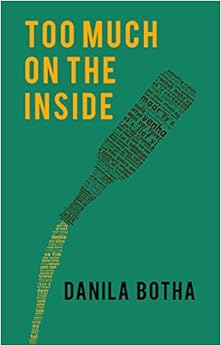
CanLit Reviews: Too Much on the Inside by Danila Botha

Full disclosure: the author sent me a copy of this book in exchange for an honest review!

Too Much on the Inside is a simple, short book about four characters from all across the world converging in one spot in Toronto. There is Dez from Brazil, Marlize from South Africa, Nicki from Israel, and Lukas from the east coast of Canada. The book is told with alternating POVs from each of these four characters. Throughout the book you get to see their interactions with each other, and learn about their lives before moving to Toronto in short snippets. I honestly think a lot of people would enjoy the simple, straightforward style of this book and the small observations about life from the places these characters are from, as well as in Toronto.

However, I kind of wanted something that went deeper. The writing was very simple, and I felt like I was being told the characters' emotions instead of really feeling the characters' emotions. I think it had the potential to be a really beautiful, emotional story with the lives of these four characters' intertwining, as well as learning from their pasts and moving forward. The premise is great, which is what made me want to pick up the book in the first place. But it just stayed on the surface level, and relied on ancient tropes and cliches rather than doing anything new or interesting. Even the problems that each character had had an obvious solution, which was just postponed until the end when the characters conveniently found themselves and realized something that I could have told them after the first couple of chapters.

I liked the idea of the story, but it just didn't work for me, because it didn't make me feel anything. I didn't care enough about the characters to want to spend more time with them after the last page.

You can find it on Goodreads here.
Danila Botha's website

Saturday, September 5, 2015

Write Whatever Every Day

For most people, January is goal-setting month, the month for resolutions for living better, healthier, and getting stuff done. For me, September always seems to be the time when I think of ways that I can improve my life. It does make sense since for the past 15 years I've been starting school in September, so it's always made me think of fresh new starts. So, anyway, I've given myself a new goal.

It started when I was organizing some old journals of mine that I've kept from when I was younger. A lot of those journals I used for writing, and flipping through them all I could think was, sheesh, I used to write a lot. And I wrote about anything and everything. I had a story here, a snippet there, a random description of my writing space in another book... and the list goes on. Until recently, I hadn't written anything that wasn't a blog post or an essay for school in half a year. Why don't I write as much as I did when I was ten? I mean, some of the reasons are obvious, but why don't I want to write as much as I did when I was ten?

Sometimes I feel like I put too my pressure on myself in my head. I go to work on a book, and think about everything wrong with it and how far it has to go, and then just do nothing. I think of a short story idea and immediately think of all the contests I could enter it into if I make it really good, and then it just blocks me. Or I think I should work on something but don't like any of the projects or books I currently have going.

So, I decided I'm going to write like I did when I was ten. I'm just going to write whatever, every day. I'm not going to commit to a word count, or a certain project or book, I'm just going to do whatever I want. I'm going to write fanfic or paragraph descriptions of nature, or a journal entry or a short story about something that happened in my life. I'm just going to write, for me and only me, and have fun doing it. I'm not going to write anything for essays or scholarships or critique partners. It's just for me, because in the end, I do like writing, and I want to start doing it again.

I think I'll try to keep it up for the month of September, and if it goes well, hopefully I'll continue. And if you want to keep me accountable, that would be more than welcome!

Saturday, August 29, 2015

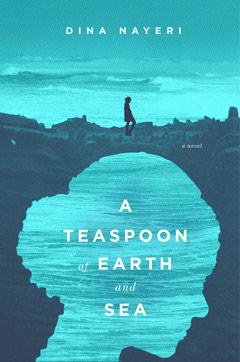
Review: A Teaspoon of Earth and Sea by Dina Nayeri

Have you ever finished a book and afterward had your heart pounding, tears running down your cheeks because of how amazingly emotional and intense the last few chapters were? 

Yeah, this was one of those books. 

I wasn't into it right away, but it definitely didn't take me long to actually want to sit down and read it rather than doing something else. The premise was interesting and kept me in suspense, the writing was good, and the characters were fun to spend time with because their personalities were written so well.


A Teaspoon of Earth and Sea follows a portion of the life of a young girl, Saba, living in Iran during the 1980s. The prologue starts with a hazy memory that Saba has of her mom and twin sister getting on an airplane to go to America, but then after that her and her father don't hear from them again.I love how it's never obvious what happened to them, and even members of her family and people in her circle of caregivers in her village aren't really sure, even after she asks. It makes it so that the entire story doesn't just rest on the main character suddenly remembering. 

However, while the suspense of what happened is what moves the story forward, it really becomes a background piece to the real heart of the story, which is Saba's character. The book follows Saba from when she's fourteen to when she's in her late twenties, and her growth over that time while she struggles with her own choices and fears. Above all it is a story about the transformation of Saba's views of herself, others and the world around her that come as a result of her own life experiences. Saba's character is inspiring to me, not because of any determination or strength she has - in fact for a lot of the book, she spends time taking the easy way out - but because she learns and grows. Really, what more do you need to make a good character?

There is so much that is good about this book. Not only are all of the characters fleshed out and present within in the story, but the writing itself is exquisitely clever. I love when authors can write one sentence that reveals everything in a way that strikes you right in the heart. I don't know how some authors do it, draw out such emotion from me with just a handful of words. (Yes, it made me cry). 

A Teaspoon of Earth and Sea is a well-written, beautiful book about a young woman’s life in Iran, and her finally coming to have the courage to stand up to herself, and I definitely think everyone should read it. 

You can find it on Goodreads here.  

Sunday, August 23, 2015

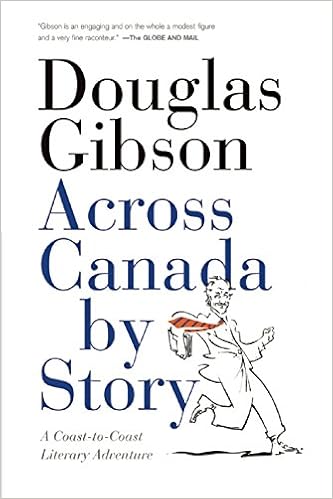
CanLit Reviews: Across Canada by Story by Douglas Gibson


Across Canada by Story is written by Douglas Gibson, who is a former editor at a major Canadian publisher. Throughout his career he published many books by well known Canadian authors. Now he's stepped onto the other side of publishing to write books. His first book, Stories about Storytellers, is a memoir about some stories he knows about the famous authors he's worked with, which I have not read yet. 

Instead I skipped to his second book, Across Canada by Story. The summary gives the impression is about his tour across Canada putting on a show based on his book, but really it's a whole bunch of stories about Canadian authors and literary places across Canada."This book of mine," Douglas
Gibson writes in the section about author Hugh MacLennan, "I hope, will give you some sense of the importance, and the literary magic, of our geography." I think that line sums up the essence of the book pretty well. Across Canada by Story is all about drawing connections between Canadian places and the literary. 

However, it is definitely written for a very specific, very Canadian audience. If you're looking for an introduction to CanLit, this is definitely not the book. Gibson talks about the authors and events in his book as if you grew up hearing about these things, which I'm sure a lot of people have. Since I'm relatively new to the CanLit scene (and relatively young), I hadn't heard of a lot of the authors that he told stories about, so I think I lost some of the enjoyment of it as a result. 

But the writing is good, witty and upbeat, and the enthusiasm the author has for Canadian literature is evident. If you’ve heard of and know well the people and places he’s writing about, then I’m sure it makes a great, fun collection of little stories about beloved Canadian authors. If you haven’t, it’s obvious the Gibson isn’t catering to you. He doesn’t really go into much explanation and kind of assumes you know a lot about the CanLit literary scene, which I’m sure there are a lot of people out there that are knee-deep in that scene that would find this book delightful. It’s just because I wasn’t the target audience that I enjoyed it a little less, that’s all.

It has encouraged me to go and search out more CanLit though, because it’s made me realize how much I’ve been missing out on, even books that are considered classics in Canadian literature. While I did struggle to get through some parts of the book, thanks to mostly the organization of it (all the chapter section titles were at the beginning of the chapter, which made each section flow kind of awkwardly from one to the next), I did still enjoy some of the stories. I think my favourite story was about Will Ferguson (author of 419) working as a tour guide on PEI and pretending that he could speak Japanese.

The best part about this book, though, is how Douglas Gibson connects Canadian geography and places with not just Canadian books, but Canadian literary places such as indie bookstores, events, or even bookish people, like bookstore owners. He paints a picture of Canada and its literature that is rich with things to be discovered. If you’re passionate about Canadian literature and its history within Canada, and want to learn some quirky stories about your favourite Canadian authors to boot, I’d say definitely give this book a read. 

Also there is currently a giveaway for this book on Goodreads! If you'd like to try to win a copy, you can enter here.


Saturday, August 15, 2015

Why You Should Read


I used to think that it was okay that some people didn’t read. Whatever, that was their life choice, not everyone is into reading. I mean, of course I wanted to everyone to be into reading because I love it, and I want to everyone to experience the awesomeness of reading like I do, but when it came down to it, people could do what they wanted.

Since then, I've changed my mind. Now, I think, yes, everyone should read. I don’t care what people read, I just want people to read, something, ANYTHING. I believe wholeheartedly in the quote by Frank Serafini about how there’s no one who doesn’t like to read, there’s just people who haven’t found the right book. There are billions of books out there, of all genres, and I’m sure that somewhere out there, you can find books that you enjoy, at your reading level and within your interests. 

Just looking at my family, you can see how diverse reading tastes are. I mostly read YA fiction and dabble in a bit of adult and nonfiction. My dad reads mostly nonfiction. My mom likes adult thrillers and mysteries. My brother will read anything as long as you literally hand it to him. My sister likes books based on movies, or fun MGs, or even better yet, fun MGs that have a movie adaptation. We definitely don’t all read the same thing, but we all read. I’ve come to believe that reading books is extremely important, and I’d almost say necessary. 


Why do I think reading is so important?

One reason is that through reading, I have the opportunity to enter into someone else’s experiences and thoughts. I don’t think there is anything that is more powerful than a book in helping people step into someone else's shoes. I have lived so many different lives, often very different than mine, through reading. 

I know that it's possible to learn about other people's experiences through TV or documentaries or YouTube videos. But I think that books are much more effective at doing this. Often, especially in fiction, you are forced to take on the perspective of the main character. Even in nonfiction, you’re reading from the perspective of the author. You are thrown directly into that person’s perspective, and you are tied to it through the words that you are putting into your brain. The most obvious example of this would be first-person fiction. You are privy to the very inner thoughts and feelings of someone who is not you. 

How amazing and powerful is that?

The power that books have in connecting you deeply to someone else’s experiences is so incredibly important. First of all, when you have internal access to someone else’s lives and experiences, or another place in history (depending on what the book is about), I think it is almost impossible not to develop empathy for that person. 

Not only are you drawn into creating a personal connection with the characters, author or situations you read about, but you become a participant in those experiences yourself. When you read, you don't experience things second-hand like you do when you watch things happen on TV. Through the characters or author, you are participating directly in the author/character’s experiences. I’m sure you’ve probably heard people talk about getting lost in the world of a book, or feeling like the characters or world was real. In a really good book, I forget who I am and where I am. I am completely taken over by the lives of who or what I’m reading about. 

As a result of that deep, personal connection with the world of the book, empathy for the characters in the book is almost inevitable. You know exactly how it feels because you basically experienced it yourself. 

Of course the most important thing is that in the end, it’s not just empathy for the characters or the author. In the end, it’s empathy for people, for humans in general. It’s empathy for the people around you in your life. 

First, characters help give you an understanding of other people’s perspectives and experiences, and then you can apply that to your own life. You can begin to understand and feel for other people, because you are now able to share in what other people experience, or know what other experiences are like. You can realize the multitude of other experiences outside of your own. This is also why I think it’s also incredibly important to read diversely – to read books with characters that have different abilities or skin colour than you, or books about places other than where you live. 

Of course, it doesn’t stop with empathy. Books also have power to open your mind to so much. Learning is a huge part of why I love reading. I love learning. Learning is important for moving the world forward, for helping to get rid of prejudices, to help realize past mistakes and move beyond them. 

There is so much to be discovered through the world of books, both fiction and nonfiction. In fiction, learning comes from what I’ve already talked about in regards to empathy and other people’s experiences. Fiction also helps you to learn about the essence of who we are as humans. I could tell you about countless YA books I’ve read that have taught me about what humans are like and the strength people can have through so many situations. And in both fiction and nonfiction, there is so much to learn about everything, every topic you could imagine. Different countries, different places, different people, science, history, conflict... the list goes on. 

I know that nowadays there is an infinite amount of information available, thanks to the internet. But I think what makes books unique is that personal connection I’ve already talked about, that connection between you the reader and either the characters or the author. There is something deeply intimate about reading a book, that creates an inner personal experience and connection that just can’t be achieved in the same way anywhere else.  

In order to truly learn empathy and other things about the world, it is definitely necessary to read widely, and diversely. I admit that I’m not the greatest at this always. I often like reading inside my comfort zone, who doesn’t? I’m working on it, though. The world is a huge place, and it encompasses billions of stories. Why should you limit yourself to learning about one specific, particular experience? Reading should not only be about identifying with experiences similar to your own, but also about learning about experiences vastly different from your own. Every time I read a book about something so very different from my own life’s experiences, it causes me to step back and think.

That’s another thing that books do – they make you think. Or I think that’s what they should do, anyway. If you’re reading diversely, about people’s experiences, then you end up thinking about those experiences and the implications of them in regards to your own life. Books have opened my mind to so many new ideas, or opened up different perspectives on old ideas, or they’ve forced me to re-examine my own thoughts and make me ask myself why I think a certain way. Or they’ve made me think about human experiences. I think about different things, depending what book I’m reading, but they make me think.

So of course, I think you should read. I think reading helps people empathize, learn about the world, and think critically. My mind is blown open a little bit more each time I read a book. I think if everyone read books, widely and diversely, the world would be just that little bit of a better place.

Also, I love reading, and I want everyone to love it as much as I do. Just don’t stop looking for that “right book”. And whatever you do, please, please read.

Sunday, July 19, 2015

Across Canada Reading Challenge Part 2: The Territories

If you weren't already aware, I finished my Across Canada Reading Challenge, which is a mini-challenge I gave myself as part of the Around the World Reading Challenge. I talked about the books I read set in each of the 10 Canadian provinces yesterday, and today I'm going to talk about the books I read that were set in each of the three territories. The three territories are the Yukon, Northwest Territories, and Nunavut. I didn't know this until now, but apparently the difference between provinces and territories is that provinces receive their power from the Constitution Act, and and the territorial governments get power from the federal government. 


YUKON

For the Yukon I read The Slow Fix by Ivan E. Coyote, which is a collection of short stories about the life of the author. A lot of the stories were about what gender is or should be, and different people and society's interpretation of it. There were also a few stories that were focused on the author's upbringing in the Yukon. I loved this book, it was such a fun and entertaining read. I think I was smiling the entire time I was reading it. It was so nice to read something light and funny, but also intelligent, after reading many brain-stretching books. The author had such a perfect quirky voice that brought life to the everyday stories she told, but also had good things to say. I think even if you aren't into reading it'd be a good book to read, since the stories are short and entertaining.

NORTHWEST TERRITORIES

For this territory I read Late Nights on Air by Elizabeth Hay. This was a book set in the 1960s or 1970s, about the community at a radio station in Yellowknife. At the same time as it was about this northern radio station, there was also the issue of a pipeline and native land rights in the background. That was interesting to read about, especially since the same kind of thing is happening now. However, it was mostly a simple, very slow moving story about the lives of the staff at this radio station. Although it was slow, I found myself getting attached to the characters and their relationships with each other anyway. The best part, though, were the descriptions of the land in the north that make you feel as if you were a part of this epic landscape, just as much as the characters in the book.


NUNAVUT


I read Consumption by Kevin Patterson, which is set in a bunch of different places in Nunavut, and some characters also spend some time in Manitoba. (The author himself is from Winnipeg). This was a really interesting book. It followed the life of a handful characters, centering around the life one Inuit girl, Victoria, and her life after she contracts tuberculosis. She's then sent to Winnipeg for an operation, and when she comes back she feels removed from her original culture, and she goes on to marry a white man. The book goes on to follow the lives of various characters who live in the north, from Victoria's kids and parents, to a couple of teachers at one of the schools, to a few other characters who live in the same community. It covers quite a few years, from when Victoria is a young girl to when she has grandkids, I think. One of the major themes is definitely how the culture changes in this northern community over those years, and how each of the characters are affected by that. 

I loved reading about the North of Canada, just because it's so very different and removed from the rest of Canada. (I do regret that I didn't read any books set in the territories by Aboriginal authors, though). There are two similarities that are prominent in each of these Northern stories. One is the theme of land. It's amazing how much the place itself defines the people that live there. Life in the north, the characters and authors of these books tell me, is something beautiful and special and something that you don't understand if you haven't experienced it for yourself. In each of the three books, the descriptions of the land and the natural atmosphere completely take you in and transport you to that place and time. The other theme, in contrast with the theme of the natural, harsh landscape, is that of the loss of culture (indigenous culture in particular) to Western cultural values and consumerism. In one of the stories in The Slow Fix, Ivan E. Coyote talks about how one of the cities in the Yukon has been taken over by Walmarts and McDonalds. The entire story in Consumption is about how many of the indigenous characters have been taken away from or have no choice but to turn away from the only way of life they knew previously, that is living off the land. 

I think the last line of Consumption brings these two themes together beautifully: 


“The narwhals surface in the bay, waving their tusks in the air; only a few miles out of town, the last of North America’s great herding land mammals, the tuktu, caribou, paw the grass and the moss by the many thousands and shiver collectively when they smell predators approaching. Contained within this beauty, and perhaps its necessary consequence, are the people here—who huddle similarly close and watch for one another’s peril.”


LinkWithin

Related Posts Plugin for WordPress, Blogger...