skip to main |
skip to sidebar
As you may have noticed on the sidebar of my blog, I have now committed to start posting every Monday. I wanted to do this so I won't procrastinate on writing blog posts, and also maybe it'll force me to write blog posts that I normally wouldn't write, stuff that turns out to be blatherings squeezed out on short notice. I also wanted to have a goal this year of talking more about my personal writing, which is something I normally shy away from on the blog most of the time. I thought that probably if I was scrambling for things to post about, it'd be more likely I'd fall back on talking about my writing (because that's basically what people do on writing blogs).
The other day I saw Les Miserables for the first time. It was amazing, and I'm fairly certain I was on the verge of tears for almost the entire movie. I love things like that, whether it be books or movies or any form of art, that evoke such emotion from you, and make such an impact on your emotions or your mind. I love how much story, no matter what form it's presented in, can affect a person.
When I feel affected by a story (like Les Mis), it inspires to affect other people with the stories I have to tell. @CostelloShields summed it up perfectly on twitter:
"I want to write things that matter. I want to write things that people will love."
That's exactly what I want to do with my writing, and brilliant stories like Les Mis, or The Fault in Our Stars, or Okay for Now, or Life of Pi, or even the Lizzie Bennet Diaries make me want to do create stories that matter even more. I want to write something that will affect others in the way all these other stories have affected me.
I love it when I come home from a movie or when I finish reading a book, and the first thing I want to do is write.
What kinds of things create a desire to write in you?
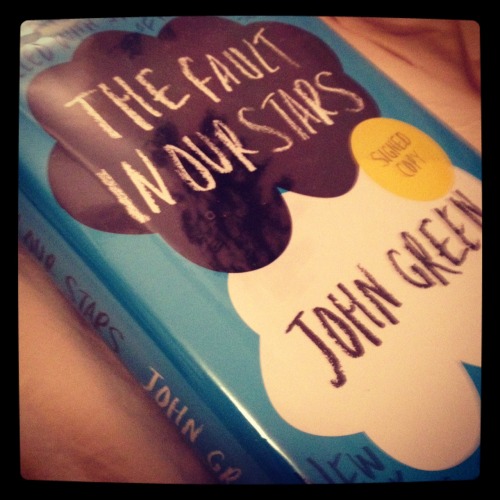
I just finished The Fault in Our Stars by John Green, which yes, is a good book. I think the thing that strikes me most about John Green's writing (other than the fact that he writes beautifully) is how achingly real what he writes feels.
OK, now is the part where I try and tell you what I'm talking about.
There are lots of books about death, and I've read a lot of books about death. After a while, they start to seem the same. The characters always go through the same motions, act the same way, deal with the same issues, and after a while I get sick of it, and it seems fake.
I don't know, maybe these people draw from their own experiences, but when I read these kinds of books it doesn't seem like they do. I think a lot of writers end up falling into the same old stereotypes and ways of presenting things because that's what they know, and that's what they've read all the time. I know I've done it. When I was in middle school, I started a bunch of stories centred around popularity and yup, there were those typical Mean Girls and Best Friend Group of Three that pop up in YA ALL THE TIME. I wrote that stuff because that's what I read and that's what I knew.
But it wasn't real. Popularity in real life, at least I find (or at least in my school), is absolutely NOTHING like it is in books.
I think in order to avoid falling back into the regular stereotypical fluff, we have to draw from our own experiences, but in a way that you put all or almost all of yourself into what you write.
Sometimes when I do things like go to a funeral, or spend time with my family, or even go bike riding, or anything in real life I'll be taking notes in my head of what I'm experiencing and what I feel like at that moment. I try to remember every detail. And I don't dramatize or anything, I just bring to focus what I'm thinking at those moments, what I'm experiencing. (These kinds of thoughts are also usually present in journals and diary entries). One thing I always find is that I'm noticing and experiencing things a lot different than characters in books usually do.
But what I'm experiencing is real, and the books are not. I know fiction books are just that: fiction. But that's not an excuse to not write things that aren't real and clear and truth.
Here I shall insert a John Green quote that I've used before:
Lies are attempts to hide the truth by willfully denying facts. Fiction, on the other hand, is an attempt to reveal the truth by ignoring facts.
Fiction is an attempt to reveal the truth. If us as writers are trying to reveal the truth, then why are we so quick to fall back into the old stereotypes and clichés and why are we as readers so willing to accept them?
I know pouring yourself into your writing is hard, REALLY hard. Walter Wellesley Smith got it right when he said, "There's nothing to writing.
All you do is sit down at a typewriter and open a vein." Opening veins is painful and difficult but also, I think, necessary in a way in order to reveal the truth.
So, yeah, that's what I mean when I say that John Green's writing is "achingly real", and if you want to learn to write like that or you just want to read a good book, go read The Fault in Our Stars. Please.




 Posts
Posts

